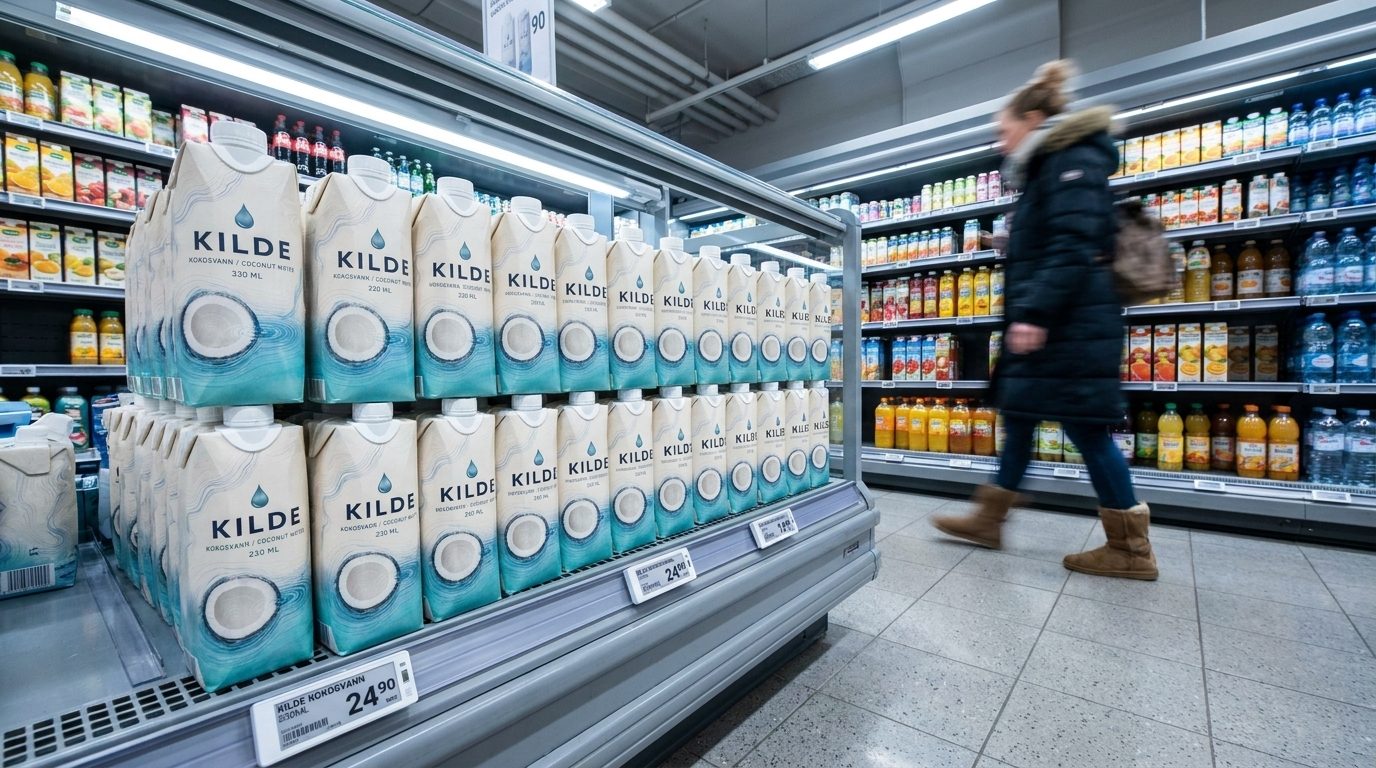
Hyllene vi skal inn i · the Scandinavian shelf
A full category study: market size and growth, brands on shelf and their retail prices across all three Scandinavian markets, distribution channels, consumer health awareness, and the strategic opening for a challenger brand. Every figure is tagged verified or estimated in the fact-check appendix.
Analyst houses disagree on exact numbers but agree on direction: coconut water is one of the fastest-growing non-alcoholic categories in Europe, driven by health-consciousness, sugar reduction, and natural-electrolyte positioning. Scandinavia trails the UK and Germany in per-capita consumption — which is the opportunity, not the problem.
Global market estimates for 2025 range from USD 3.76 bn (Mordor) to USD 5.14 bn (Grand View), with forecast CAGRs of 5.7–18% depending on methodology. Tetra Pak is the dominant packaging format at ~52% share. North America leads with ~37–38% of revenue.
Europe was worth ~USD 1.57 bn in 2025, forecast to reach USD 4.8 bn by 2034 (13.3% CAGR, Market Data Forecast); Grand View projects an even steeper 20.2% CAGR to 2033. The UK is the largest single market (~22% of Europe); Germany the fastest-growing major market.
No analyst publishes a standalone Scandinavian figure. Scaling from population, the German benchmark (~50–70 m litres for 84 m people) and observed shelf penetration suggests Norway + Sweden + Denmark together consume roughly 8–15 m litres/yr — an early-cycle market with UK-style headroom.
Category logic: what happened in the UK 2012–2020 (specialty → gym → grocery mainstream → private label) is happening in Germany now and has barely started in Scandinavia. The window for a challenger to enter before private label arrives is open — but it will not stay open past ~2028.
Core thesis of this study
Coconut water is available in Norway but skews heavily to specialty channels. Consumer guides confirm it can be found across Rema 1000, Coop, Kiwi and Meny, yet depth of assortment in mainstream grocery is thin — typically one facing, often placed with juice or "international foods" rather than sports/hydration. The category's real Norwegian home is helsekost (health-food) retail and sports-nutrition e-commerce.
| Brand | Origin / owner | Formats seen | Channel | Indicative retail |
|---|---|---|---|---|
| Vita Coco | All Market Europe (UK) · Solera portfolio | 330 ml · 1 L | Helsekost (Kinsarvik), sports e-com (Gymgrossisten, Bodystore, Fitness Market), select grocery | 1 L: NOK 104–115 · 330 ml: ~NOK 25–35 |
| Foco | Thailand / Vietnam | 330 ml · 500 ml · 1 L | Asian grocery, Fodda.no, ethnic retail | 1 L: ~NOK 35–55 |
| Coco Xim (Betrimex) | Vietnam | 330 ml · 1 L | Asian/US-import e-com (Norway Americana), ethnic retail | 1 L: ~NOK 40–60 |
| Chaokoh / UFC / Bamboo Tree | Thailand / Vietnam | 330–500 ml | Asian grocery & web (Fodda) | ~NOK 20–35 / unit |
| Cocofina, Dr. Antonio Martins et al. | UK / DE organic | 330 ml – 1 L | Helsekost, organic web shops | Premium, NOK 40+ / 330 ml |
Kinsarvik Naturkost lists Vita Coco 1 L at kr 104–115 — the highest coconut water price point in Scandinavia. Helsekost buyers are early adopters but low volume.
Gymgrossisten, Bodystore and Fitness Market (all HSNG group) each carry Vita Coco 330 ml and 1 L, marketed explicitly as a "natural sports drink." This channel proves the fitness-hydration occasion in Norway.
Mainstream grocery presence is confirmed but shallow; the value end of the category (Foco, Coco Xim, UFC at roughly half Vita Coco's price) lives almost entirely in Asian-food retail and web shops like Fodda.no.
Sweden is a full step ahead of Norway. Vita Coco sits in the national grocery majors — ICA, Coop and Hemköp all list it online — and in the pharmacy e-commerce giant Apotea. Coop even carries a second, cheaper brand (Coco Island), an early sign of category laddering. Price levels are strikingly lower than Norway: Vita Coco 1 L retails around SEK 42.50–46.95 (≈ NOK 44–49) and the 330 ml around SEK 19.50–23.95.
| Brand | Retailer | Format | Price | ≈ per litre |
|---|---|---|---|---|
| Vita Coco Naturell | Coop.se | 1 L | SEK 42.50 | SEK 42.50 |
| Vita Coco Naturell | Hemköp / Stockholm avg. | 1 L | SEK 46.95 | SEK 46.95 |
| Vita Coco Naturell | Coop.se | 330 ml | SEK ~19.50 | SEK ~59 |
| Vita Coco Naturell | Hemköp | 330 ml | SEK 23.95 | SEK ~73 |
| Coco Island | Coop.se | 330 ml | value tier | below Vita Coco |
| Vita Coco (pharmacy channel) | Apotea.se | 330 ml | listed | — |
Distribution learning for KILDE: Sweden shows the category's natural grocery price architecture — a branded leader at ~SEK 42–47/L and room beneath it for a value/challenger tier. Sweden is also the logical Phase-3 expansion market since the same 3PL and marketing assets reach it from Oslo.
Denmark has Scandinavia's deepest coconut water assortment. Category guides report availability across Føtex, Bilka, Netto, Rema 1000 and Lidl, plus online at nemlig.com, Coop.dk, Matas and Helsebixen. Danish consumer guidance puts standard 330 ml cartons at DKK 15–25, organic 330 ml at DKK 25–35, and 500 ml bottles at DKK 25–40. The value end is aggressive: Foco 1 L sells for around DKK 30 in Asian-food web shops.
| Brand | Where | Format | Price |
|---|---|---|---|
| Vita Coco | Bodystore.dk, grocery | 330 ml · 1 L | mid–premium tier |
| Foco | Asian grocery / web (Pandasia, Den Kinesiske Købmand) | 350 ml · 1 L | 1 L ≈ DKK 30 · 350 ml ≈ DKK 25 |
| Cocomax | nemlig.com | bottle | value–mid |
| Innocent kokosvand | nemlig.com, grocery | chilled | premium chilled |
| Generic / standard cartons | Netto, Rema 1000, Lidl | 330 ml | DKK 15–25 |
| Organic cartons | Helsam, Matas, grocery | 330 ml | DKK 25–35 |
Denmark demonstrates the endgame Norway will reach: discounter presence (Netto, Lidl), a chilled premium segment (Innocent), a strong Asian value tier, and organic as the price ceiling. Danish per-litre prices are the region's lowest — roughly half of Norway's.
The single most important fact in this study: Vita Coco 1 L costs ≈ NOK 44–49 in Swedish grocery and NOK 104–115 in Norwegian helsekost — a 2.2× gap on the identical product. That gap is not tax (beverage excise is abolished; VAT is comparable). It is a distribution-structure premium: thin assortment, specialty-channel margins, and no challenger pressure. A grocery-priced challenger at NOK 45–55/L can undercut the incumbent by half while still earning 40%+ gross margin on a landed cost of ~NOK 16/L.
Price-gap analysis · KILDE Kokosvann
Coconut water is consistently marketed and perceived across Nordic retailers as a "natural sports drink" — high potassium, isotonic profile, low sugar. Every Nordic e-tailer selling it (Gymgrossisten, Bodystore, Apotea) leads with the training-recovery message. This is the category's proven purchase driver.
European growth is explicitly driven by consumers replacing sugary soft drinks with low-calorie natural alternatives (~18–21 kcal/100 ml). Danish retail copy positions coconut water directly as "a healthier alternative to soda." Nordic sugar-awareness is among Europe's highest.
Organic is the fastest-growing nature segment in Europe (Grand View; ~8.6% CAGR globally per FMI) with ~50% FOB price premium. In Denmark organic 330 ml already commands DKK 25–35 vs 15–25 standard. An EU-Organic KILDE SKU is the margin play.
100% single-ingredient, vegan, fat-free, no preservatives — coconut water matches the Nordic clean-label checklist perfectly. Keyhole-style shopping filters (nøglehul) on Danish price portals show consumers actively filter for these attributes.
Norway's exceptional gym density plus the urban fjord-sauna boom create two native rehydration occasions. Post-sauna hydration is culturally ownable and currently claimed by no brand — the KILDE × Saunaegruppen angle.
Retailer copy across all three markets pushes smoothie-base, cocktail-mixer and cooking use — Vita Coco globally markets itself as a cocktail mixer and hangover remedy. The 1 L format grows on the back of these multi-serve occasions.
Consumer-facing content in all three languages converges on the same claims: rich in electrolytes (potassium ~200 mg/100 ml, magnesium), effective rehydration after exercise, low calorie (~13–21 kcal/100 ml), and antioxidant/vitamin-C content. Danish sports-nutrition media notes some studies indicate coconut water rehydrates comparably to commercial sports drinks with less sugar. Awareness is high among the fitness-active urban demographic; household penetration remains low (German benchmark: below 20%), meaning the growth curve is still in front of us. Marketing claims for KILDE must stay within EU/EEA nutrition-and-health-claim rules (Regulation 1924/2006 as applied in Norway) — "source of potassium" is claimable; "cures hangovers" is not.
| Player | Role | Strength | Exposed flank |
|---|---|---|---|
| Vita Coco / All Market Europe | Category leader — "largest coconut water in Europe and the US" | Brand awareness, EU stock, marketing muscle | Premium-priced; represented in Norway via a wine-and-spirits-centric distributor; thin grocery push |
| Solera Beverage Group | Norwegian importer/distributor holding Vita Coco | Horeca & Vinmonopolet machine; national logistics | Alcohol-first portfolio; non-alcoholic is a sideline — the category has no dedicated champion |
| Asian-value brands (Foco, Coco Xim, UFC, Cocomax, Chaokoh) | Value tier via ethnic grocery & web | Price (≈ half of Vita Coco), loyal ethnic base | No mainstream-grocery presence, no Nordic branding, no marketing |
| Innocent (Coca-Cola) | Premium chilled entry (DK) | Chilled-juice shelf access, brand trust | Chilled-only, high price, small footprint |
| Organic specialists (Cocofina, Dr. Martins, Coco Island) | Niche premium / secondary brands | Organic credentials | Sub-scale, specialty-channel only |
| Private label | Absent in Scandinavia today | — | Germany shows 25–30% private-label volume share is the destination; whoever supplies or pre-empts it wins |
Structural read: the Scandinavian category is a premium leader with a distracted distributor on top, a fragmented value tier at the bottom, and an empty middle — no Nordic-branded, grocery-priced, fitness-positioned challenger exists. That empty middle is precisely KILDE's lane. The secondary strategic option is to become the private-label supplier to NorgesGruppen/Coop/Rema before a German or UK co-packer does.
Positioning: "Naturens sportsdrikk — til trening, sauna og hverdag." Nordic-clean design, EU-Organic variant, transparent origin story. Price: 330 ml at NOK 19–24 shelf, 1 L at NOK 45–55 — undercutting the incumbent by 40–55% while doubling the value tier's brand quality. Channel sequence: (1) sports e-com + sauna/gym partnerships for velocity proof; (2) one regional grocery chain pilot (Oda online + one Rema or Coop region); (3) national listing pitch with 12 months of scan data; (4) Sweden. Marketing: occasion-led social content (sauna, løpetur, fjelltur), sampling at races and sauna festivals, and claim discipline under EU health-claim rules.
Each material claim below is tagged Verified (directly sourced, July 2026) or Estimate (derived/triangulated — treat as working figure until validated with primary quotes or paid data).
1Europe market USD 1.57 bn (2025) → USD 4.82 bn (2034), 13.3% CAGR — Market Data Forecast, Europe Coconut Water Market report.Verified
2Europe CAGR 20.2% (2026–2033), organic fastest-growing nature segment, Europe ~21.4% of global revenue — Grand View Research Horizon.Verified
3Global 2025 size USD 3.76–5.14 bn; Tetra Pak ~52% packaging share; North America ~37–38% share — Mordor Intelligence / Grand View / Fortune Business Insights (analyst spread disclosed).Verified
4UK = largest European market (~22.3% share); Germany fastest-growing; Germany volume 50–70 m litres 2025, household penetration <20%, private label 25–30% — Market Data Forecast; IndexBox Germany report.Verified
5Scandinavian market size USD 25–45 m / 8–15 m litres — management triangulation from population scaling of German benchmark; no primary source exists.Estimate
6Norway: Vita Coco 1 L kr 104–115 at Kinsarvik Naturkost; 330 ml carried; ingredients kokosnøttvann 99% + fruktose + vitamin C — kinsarvik.no product pages.Verified
7Norway availability in Rema 1000, Coop, Kiwi, Meny — kokosvann.no category guide; assortment depth assessment is qualitative.Verified Depth = Estimate
8Norway sports channel: Vita Coco 330 ml & 1 L at Gymgrossisten.no, Bodystore.no, Fitnessmarket.no; origin Brazil/Philippines/Sri Lanka by season — product pages.Verified
9Solera lists Vita Coco in its producer portfolio; Solera = leading Norwegian beverage supplier (Vinmonopolet, horeca, dagligvare, travel retail), Nordic group, alcohol-weighted portfolio — solera.no, LinkedIn.Verified
10Sweden: Vita Coco 1 L SEK 42.50 (Coop) and SEK 46.95 (Stockholm/Hemköp tracking); 330 ml ~SEK 19.50 (Coop) / 23.95 (Hemköp); listed at ICA, Apotea; Coco Island second brand at Coop — coop.se, ICA, nedostavka/Matspar price trackers, apotea.se.Verified
11Denmark: standard 330 ml DKK 15–25, organic DKK 25–35, 500 ml bottle DKK 25–40; channels Føtex, Bilka, Netto, Rema 1000, Lidl, nemlig.com, Matas, Helsebixen — motion-online.dk category guide + retailer listings; Foco 1 L ≈ DKK 30 (Pandasia); Cocomax & Innocent at nemlig.com.Verified
12Norway/Sweden price gap 2.2× computed at SEK/NOK ≈ 1.03 (July 2026); "not explained by tax" rests on abolished beverage excise (Skatteetaten, from 1 July 2021) and comparable food VAT.Verified inputs Gap interpretation = Analysis
13Health-awareness claims (electrolytes, potassium ~196 mg/100 ml, 13–21 kcal/100 ml, rehydration parity with sports drinks in some studies) — Apotea nutrition panel, Foco/Cocomax product data, motion-online.dk.Verified as marketed claims
14KILDE landed costs (NOK ~7 / 330 ml, ~16 / 1 L) and margin scenarios — from the KILDE Kokosvann concept dossier cost ladders; pre-RFQ working figures.Estimate
15Category-evolution timeline (UK → Germany → Scandinavia) and private-label threat window to ~2028 — management strategic judgement built on sources 1–4.Analysis
FXConversions at EUR/NOK 11.7 · SEK/NOK 1.03 · DKK/NOK 1.55 · USD/NOK 10.5, July 2026 — refresh at execution. This study is an internal working document, not investment advice or an offer; validate Estimate-tagged figures with primary quotes (supplier RFQs, Nielsen/GfK scan data, chain category managers) before committing capital.
This addendum documents the evidence and methodology behind the frameworks published on the public Market page, so the public presentation and this study remain aligned on the same release.
Norway, Sweden and Denmark are researched markets: retail prices observed directly (kinsarvik.no; coop.se; Hemköp tracking; pandasia.dk — July 2026), assortment reviewed on retailer product pages, populations from SSB/SCB/DST (2025). Finland and Iceland are explicitly unresearched: no coconut-water pricing, distribution or demand data has been collected, and no market size is estimated for either. They appear on the public page only as future validation markets. Required before any entry decision: retailer assortment audit, price observation set, category interviews, and consumer concept testing in each market.
The public page's claim structure is deliberately two-sided: high health awareness AND significant unmet need. Basis: Nordic Nutrition Recommendations 2023 (Nordic Council of Ministers) integrate health and environmental guidance; national monitoring by the Norwegian Directorate of Health and counterpart agencies reports that roughly one-quarter to one-third of adults do not meet physical-activity recommendations and that dietary quality indicators are under pressure. No claim is made that Nordic consumers are universally healthy, and coconut water is never presented as a remedy for inactivity. Denmark's organic food-retail share (≈12–13%, world-leading) is sourced from Organic Denmark and FiBL statistics (2024).
The matrix uses four qualitative grades only (High / Medium / Emerging / Validation required). Numeric scores are prohibited until a published methodology exists. Grade assignment: price and assortment dimensions follow direct observation; occasion and DTC dimensions are management analysis pending concept testing; all Finland/Iceland cells default to "Validation required". Each public cell carries its evidence note.
TAM — Europe USD 1.57bn (2025): Market Data Forecast, published 2025; cross-checked against Grand View Research (20.2% CAGR to 2033). Analyst estimates differ ±20%; both are cited and neither is presented as certain. SAM — NO+SE+DK ≈USD 25–45m/yr: German per-capita category consumption applied to 2025 populations, scaled 60–110% for relative maturity → 8–15m litres/yr, valued at observed Nordic retail prices. Management estimate; no primary scan data yet. SOM — ≈NOK 32m Y3 base case: bottom-up from KILDE_Integrated_Financial_Model_v3.5 (subscriber cohorts; outlets × units/outlet/week × reorder %; online grocery; regional pilot). SOM is never derived as a share of the analyst TAM. Next validation steps: NielsenIQ/Circana purchase, category-manager interviews, assortment audit.
Nine observed stages (ethnic/specialist → consolidation), calibrated on the UK 2012–2020 trajectory and current German development (sources 1–4 and 15 of this study). Placement of Norway (specialist → early mainstream), Sweden (early mainstream) and Denmark (broader assortment) follows the assortment observations above. The "now → ≈2028" window is management strategic judgement, not a verified deadline, and is labelled as such wherever it appears.
The six-step trend engine, twelve-month roadmap, KPI scoreboard and demand-and-distribution flywheel published on the Market page are strategy frameworks reconciled to the Marketing, Launch & Growth Strategy v3.5 and the 36-month model (500-subscriber gate M10 base; EBITDA break-even M11; CAC ≤ NOK 250; repeat ≥35%; ≥8 units/outlet/week; reorder ≥70%). They contain commitments of process, not guarantees of outcome. Guiding principle: attention is not market proof — repeat purchase and outlet velocity are.
The public trade case offers category education, sampling, DTC data and regional testing. It explicitly does not promise sales, margins, listings or category growth, and lists the proof retail requires first: verified specification, laboratory results, landed cost, shelf life, GS1 EAN, legal label review, demonstrated velocity, reliable supply.
Market Data Forecast, European coconut water, 2025 (USD) · Grand View Research, 2025 · kinsarvik.no, coop.se, Hemköp tracking, pandasia.dk — direct price observations, July 2026 (FX: SEK/NOK 1.03 · DKK/NOK 1.55 · USD/NOK 10.5) · Statistics Norway, Statistics Sweden, Statistics Denmark, Statistics Finland, Statistics Iceland — populations, 2025 · Organic Denmark / FiBL organic-market statistics, 2024 · Nordic Council of Ministers, Nordic Nutrition Recommendations 2023 · Norwegian Directorate of Health and counterpart national monitoring · KILDE Integrated Financial Model v3.5 and Marketing, Launch & Growth Strategy v3.5 (management, unaudited). Verification statuses used throughout: Verified public source · Supplier indication · Management estimate · Arithmetic checked · Pending quotation · Pending independent review.